




SC rejects age-based restrictions on internet access, says children enjoy fundamental right to access it
Sun 18 Oct 2026, 13:30:35
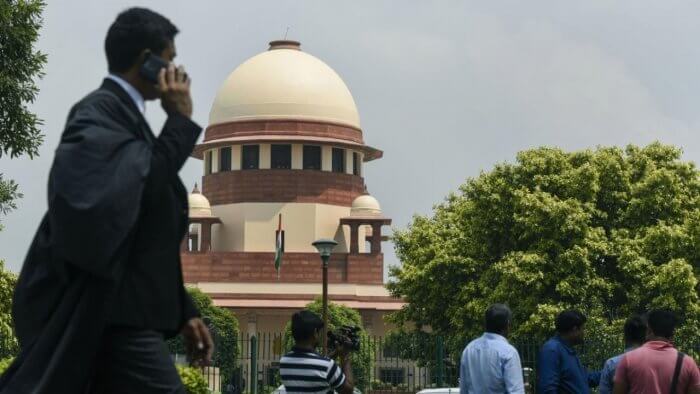
In a significant development, the Supreme Court on Saturday rejected age-based restrictions on internet access, observing that children enjoy the fundamental right to access and use the internet. The apex court, however, called for a stricter framework to protect them from online sexual abuse, including faster detection and removal of child sexual abuse material across platforms. The Supreme Court declared access to and use of the internet a fundamental right for every person, including children, under Articles 21 and 19(1)(a) of the Constitution. The court said, "The safety of our children and their freedom are not mutually exclusive."
According to a LiveLaw report, a bench of Justices JB Pardiwala and K Vinod Chandran suggested that instead of completely restricting children from using the internet, their online safety should be strengthened by implementing measures like a "child mode" for social media accounts.
During the hearing of the matter, the bench of Justices JB Pardiwala and K Vinod Chandran made the observation while issuing directions to strengthen the mechanism for detection and removal of child sexual exploitation and abuse material (CSEAM) from social media platforms and other online services.
The Supreme Court said: "We have no hesitation in holding that access to and use of the Internet is a fundamental right of every individual under Article 21 and Article 19(1)(a) of the Constitution. Our children, regardless of their age, have the same rights. To deny them
these rights completely would be as absurd as saying that children below a certain age have neither the intelligence that should be protected nor the freedom of expression that should be expressed. The safety of our children and their freedom are not in conflict. Our children should have both."
these rights completely would be as absurd as saying that children below a certain age have neither the intelligence that should be protected nor the freedom of expression that should be expressed. The safety of our children and their freedom are not in conflict. Our children should have both."
The top court bench acknowledged that the internet, in its current form, poses a risk to children's safety. However, the court noted that restricting children's access to online platforms if they fail to detect and remove harmful content would be tantamount to holding the victims responsible for the problem.
The court also considered whether children should be kept completely away from the internet and social media for their safety. The court noted that the right to freedom of speech and expression under Article 19(1)(a) includes the right to seek, receive, and impart information and ideas.
Describing the Internet as a marketplace for ideas, creative expression, and information, the Court observed that its significance is not limited to the content available online, but also provides numerous opportunities for learning, interaction, and access to information.
"For many children, especially in remote areas, it is often the only means of learning and information," the court observed. The court also noted that the Internet can be crucial for children with special needs. For them, online platforms may be the only place where they can find others facing similar circumstances.
No Comments For This Post, Be first to write a Comment.
Most viewed from National
.jpg)








Most viewed from World












Todays Epaper

English Weekly


AIMIM News


Latest Urdu News
Most Viewed
Aug 02, 2026
Should India introduce stricter laws against AI-generated fake videos and images?
Like Us
Home
About Us
Advertise With Us
All Polls
Epaper Archives
Privacy Policy
Contact Us
Download Etemaad App
© 2026 Etemaad Daily News, All Rights Reserved.