




President Droupadi Murmu approves G RAM G Bill, becomes law
Mon 22 Dec 2025, 01:30:37
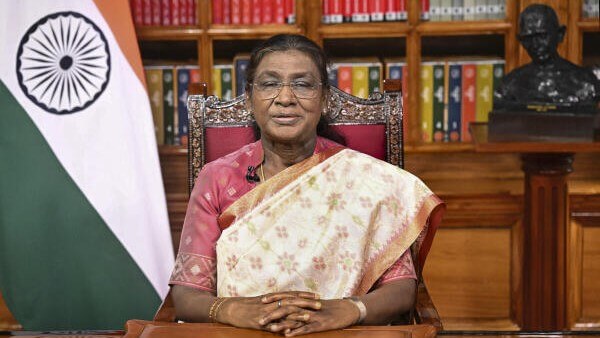
President Droupadi Murmu has given her assent to the Viksit Bharat—Guarantee for Rozgar and Ajeevika Mission (Gramin) (VB-G RAM G) Bill, 2025, formally clearing the way for a major overhaul of India’s flagship rural employment programme.
With this, the two-decade-old Mahatma Gandhi National Rural Employment Guarantee Act (MGNREGA) stands replaced by a new statutory framework aligned with the government’s Viksit Bharat 2047 vision.
One of the most prominent changes under the new law is the enhancement of the statutory employment guarantee from 100 days to 125 days per financial year for rural households. The government has projected this as an expansion of benefits, noting that the earlier 100-day limit often operated as a hard ceiling rather than a minimum guarantee.
The Bill also introduces a significant shift in funding architecture. Unlike MGNREGA, where the wage component was fully funded by the Centre, the VB-G RAM G framework mandates shared financing between the Centre and states.
The proposed funding pattern is a 60:40 Centre-State split, replacing the earlier Centre-heavy models of 90:10 for northeastern and Himalayan states and 75:25 for
others. The government has argued that this change will promote cooperative federalism and give states greater ownership of outcomes.
others. The government has argued that this change will promote cooperative federalism and give states greater ownership of outcomes.
For the first time, the rural jobs law allows employment to be paused for up to 60 days during peak sowing and harvesting seasons. The stated rationale is to ensure adequate availability of farm labour and address farmers’ concerns over labour shortages during critical agricultural periods.
The scope of permissible works has also been narrowed. Under the VB-G RAM G Act, employment will focus on four defined verticals: water security, core rural infrastructure, livelihood-related assets, and climate resilience. The government has said this will improve the quality and durability of assets created under the scheme.
While the government, led by Prime Minister Narendra Modi, has maintained that the new law aligns with the Viksit Bharat at 2047 vision, the Opposition has raised strong objections. Congress leaders Rahul Gandhi and Priyanka Gandhi criticised the omission of Mahatma Gandhi’s name from the legislation and argued that the Bill dilutes the rights-based core of MGNREGA, centralises decision-making and weakens workers’ entitlements.
No Comments For This Post, Be first to write a Comment.
Most viewed from National



Most viewed from World






Todays Epaper

English Weekly


AIMIM News


Latest Urdu News
Most Viewed
May 26, 2020
Which cricket teams will reach the IPL 2026 finals?
Latest Videos View All
.jpg)
.jpg)
.jpg)

Like Us
Home
About Us
Advertise With Us
All Polls
Epaper Archives
Privacy Policy
Contact Us
Download Etemaad App
© 2026 Etemaad Daily News, All Rights Reserved.