




IND vs NZ 1st T20I: India register comfortable win after hammering New Zealand by 48 runs
Thu 22 Jan 2026, 01:25:45
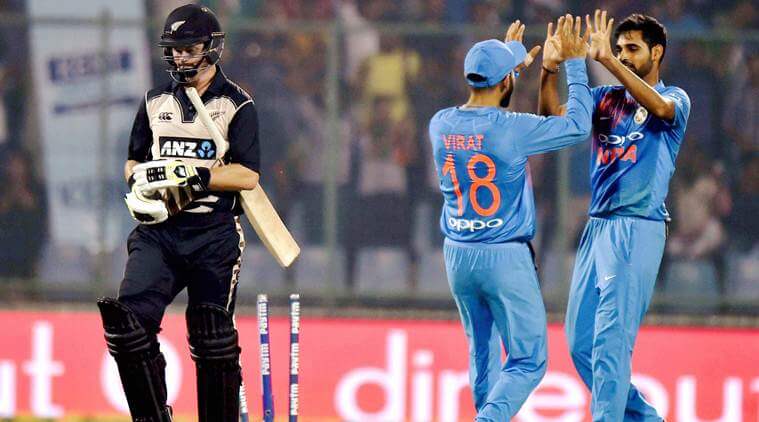
Abhishek Sharma produced a scintillating display as India crushed New Zealand by 48 runs in the first T20I at the VCA Stadium in Nagpur on Wednesday, January 21, to take a 1-0 lead in the five-match series. In a high-scoring contest that saw over 400 runs scored, Abhishek’s explosive batting proved decisive, setting the tone for India’s dominance.
New Zealand threatened briefly in a daunting chase of India’s record-breaking total, but the target ultimately proved out of reach. Abhishek’s fearless strokeplay underlined why he is widely regarded as the next big thing in Indian cricket, as India delivered a statement win in the series opener.
After being asked to bat first, India unleashed a blistering batting display to script history, posting their highest-ever T20 total against New Zealand with a commanding 238 for 7. In the process, they surpassed their previous best of 234 for 4, set in Ahmedabad in the match in 2023 where Shubman Gill registered his maiden—and so far only—T20I hundred. The scale of the achievement was amplified by the manner in which India recovered from a shaky start at the top.
Sanju Samson fell early for 10, unable to make the most of his opportunity, while Ishan Kishan’s long-awaited T20I comeback after two years also failed to take off. The left-hander managed just eight off five balls before getting out to Jacob Duffy, leaving India at a precarious 27 for 2. What followed, however, was a breathtaking counterattack that decisively swung the momentum.
Abhishek Sharma and Suryakumar Yadav tore into the New Zealand attack with fearless intent, dragging India out of trouble and into a position of dominance. Abhishek was at his destructive best, racing to a 22-ball fifty, the fastest by an Indian against the Black Caps in T20Is. He also brought up 5,000 T20 runs, underlining his growing stature in the shortest format. The left-hander looked set for his third T20I hundred before Ish Sodhi finally broke through, but not before Abhishek had smashed a sensational 84 off just 35 balls, an innings studded with five fours and eight towering sixes.
At the other end, Suryakumar played the ideal foil, striking a fluent 32 off 22 deliveries with his trademark innovation. Although his wait for a T20I fifty stretched to 23 innings after he fell to Mitchell Santner against the run of play, the Indian skipper still reached a significant milestone, becoming the fourth Indian to complete 9,000 T20 runs. Together, Abhishek and Suryakumar added a crucial 99-run stand for the third wicket, laying the foundation for a massive total.
With both set batters dismissed in quick succession, India needed impetus at the death—and Rinku Singh delivered in emphatic fashion. Reinforcing his reputation as one of India’s finest finishers in the game, Rinku hammered an unbeaten 44 off 20 balls, punishing anything in his arc. His assault on Daryl Mitchell in the final over, which yielded two fours and two sixes, provided the perfect flourish. Hardik Pandya complemented him well with
a brisk 25 off 16 balls, ensuring the run rate never dipped.
a brisk 25 off 16 balls, ensuring the run rate never dipped.
For New Zealand, Jacob Duffy was the standout with figures of 2 for 27, while Kyle Jamieson also claimed two wickets but proved expensive, conceding 54 runs. Ultimately, India’s depth, power, and relentless intent proved overwhelming as they closed the innings with authority and momentum firmly on their side.
New Zealand were on the back foot almost immediately in a daunting chase of 239, with India striking twice inside the first two overs to set the tone for a dominant defence. Arshdeep Singh drew Devon Conway into a tentative poke outside off, the opener edging behind for a two-ball duck, before Hardik Pandya cramped Rachin Ravindra for room, forcing a miscued shot that left the visitors reeling at 1 for 2 in just 1.3 overs. From there, the equation always looked forbidding.
Tim Robinson and Glenn Phillips attempted to steady the innings, injecting some momentum into the powerplay as New Zealand reached 50 by the end of the sixth over. Robinson looked lively during his 15-ball 21, but with the required rate already ballooning past 13.5 an over, the pressure never eased. Varun Chakravarthy then produced a moment of class to deceive Robinson in flight, breaking the stand and tilting the contest firmly in India’s favour.
Phillips, however, refused to surrender. Joined by Mark Chapman, he launched a spirited counterattack, the pair adding 79 runs in just 42 balls to briefly keep New Zealand in the hunt. Phillips was particularly brutal, finding gaps with ease and clearing the ropes at will as he raced to a 29-ball half-century. Chapman played the supporting role effectively, rotating the strike and punishing loose deliveries, but the mounting asking rate meant the Kiwis were always chasing the game rather than controlling it.
The decisive blow came in the 14th over when Axar Patel dismissed Phillips, who had been New Zealand’s last real hope. Phillips departed for a valiant 78 off 40 balls, studded with four fours and six sixes, but with 108 needed from the final 39 deliveries, the contest was effectively sealed. India tightened the screws thereafter, allowing no late surge.
There was a brief moment of concern for the hosts when Axar suffered a finger injury after stopping a ferocious drive from Daryl Mitchell, forcing him off the field with a bleeding left thumb. Abhishek Sharma completed the over without further damage, and India’s control never wavered. Mitchell and skipper Mitchell Santner chipped in with 28 and an unbeaten 20 respectively, but their efforts were cosmetic rather than threatening.
India’s bowling effort was well-rounded, with Varun Chakravarthy and Shivam Dube claiming two wickets apiece. Dube was even on a hat-trick before Kyle Jamieson denied him that feat. Ultimately, India’s early strikes, disciplined middle-overs bowling, and relentless pressure proved decisive as they sealed a comprehensive win and carried strong momentum into the second T20I in Raipur on January 23.
No Comments For This Post, Be first to write a Comment.
Most viewed from Cricket
Most viewed from Sports


.jpg)




Todays Epaper

English Weekly


AIMIM News







Latest Urdu News
Most Viewed
May 26, 2020
Which cricket teams will reach the IPL 2026 finals?
Latest Videos View All
.jpg)
.jpg)
.jpg)


Like Us
Home
About Us
Advertise With Us
All Polls
Epaper Archives
Privacy Policy
Contact Us
Download Etemaad App
© 2026 Etemaad Daily News, All Rights Reserved.